The Perils of Pauline Part II Jim and Aleda Littlefield
Wait! Where was I? Oh, yes, telling the story of Pauline Ostrom Youngberg. In the previous episode we told how Pauline emigrated to the United States from Sweden in 1890 when she was 19 years old. She first lived in Chicago and then moved to Denver where she married Fritz Youngberg, also from Sweden. She was a victim of an embezzlement, now they’re called “scams”. This was quite a popular news item in 1906, being found in newspapers all across the west with headlines such as “He was a smooth one” and “invested money on ‘spirits’ advice”. We also know that Aleda’s mother Alice likely visited her Aunt Pauline sometime and in fact, Alice probably worked in Colorado, though the exact details are uncertain except for a couple of photographs of Alice, labeled “Denver”, appearing in a maid’s uniform.
Figure 1 · Preserved with the original essayFigure 2 · Preserved with the original essay
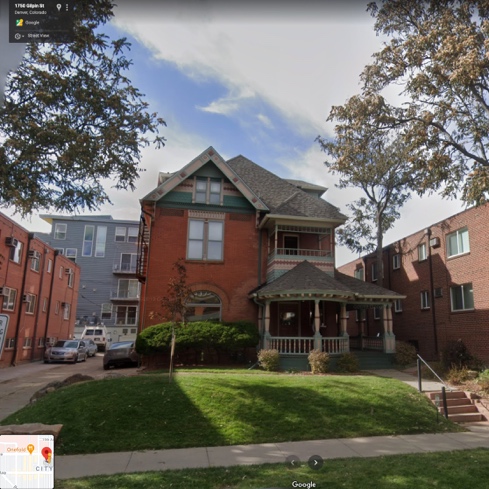
For Pauline, things were relatively uneventful through the middle years until 1921. In 1906 her house was quite modest. It seems that Pauline did quite well as a landlord and investor and by the early 20’s Pauline was the owner of several apartment houses. Things were apparently not doing quite that well between she and Fritz and by 1921 they had been living apart for seven years. She was living at 1751 Gilpin Street, a house which still stands today and one can see it is more than just a modest place. In 1920, Fritz is listed as a machinist with the Denver and Rio Grande railroad and continued as such through most of his life.
The Murder Mystery
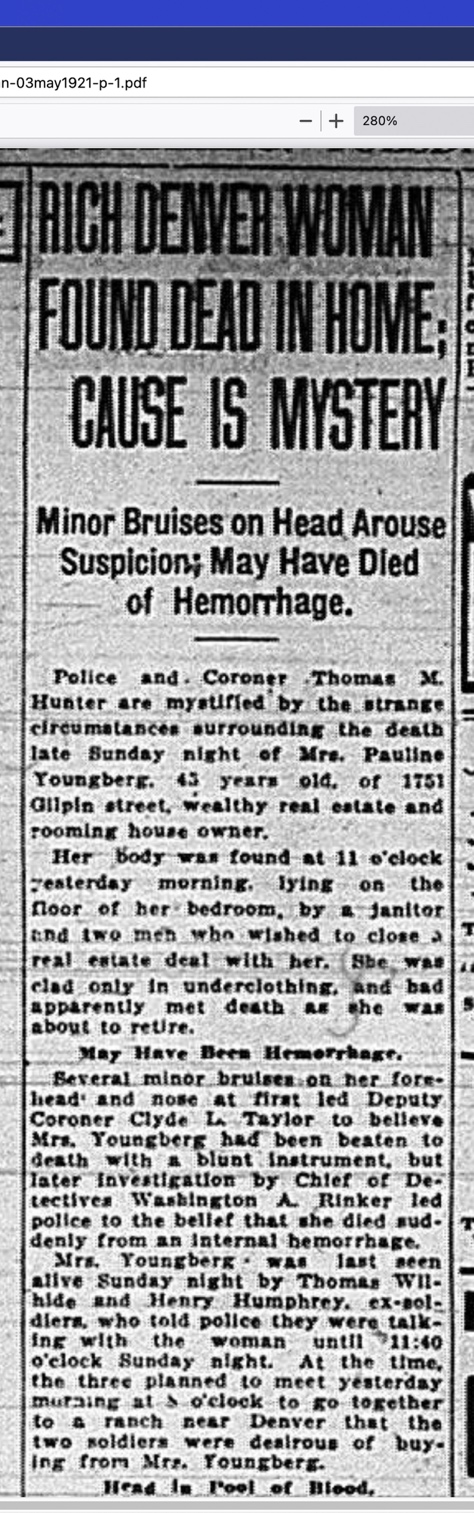
The following is taken extensively from the attached articles in the Denver Post and the Rocky Mountain News.
This brings us to the morning of May 2nd, 1921 in Denver. Monday morning’s Rocky Mountain News, carried the following story on page 1 (see right). To summarize, on the previous Sunday night, two men - Thomas Wilhide and Henry Humphrey (two ex-soldiers and vocational school students) - had met with Pauline about a real estate deal, talking with her until 11:40 Sunday night. Wilhide and Humphrey had been rooming in the apartment house. They were the last to see her alive. At that time they said they bade her good-night and went to their apartment on the floor below. An operative of the DeLue Detective agency, a Mr. McAfee, said he was interested in a ranch proposition with Wilhide and Humphrey and that he was at Mrs. Youngberg’s apartment Sunday afternoon until 5:30 pm. They were to meet with her early Monday morning to look at the ranch property which they were trying to buy from her. They said she promised to call for them and when she did not appear they started looking for her. Andrew Lindbert, the janitor, said he was bothered when Mrs. Youngberg failed to appear for breakfast.
When she did not show-up the two men and the janitor went to her apartment at 11 o’clock and forced open the door. The headline in the Denver Post that day read, “Her skull crushed and body ‘laid out’ in own apartment”; Police have no clew (sic) to murderer who locked the door as he escaped. Mrs. Pauline Youngberg, Extensive Property Owner, was last seen alive at home late Sunday night.” The next day’s Post (May 2) reported, “Mrs. Pauline Youngberg Found in Roo
Figure 3 · Preserved with the original essay
m at Gilpin Street Home with Skull Crushed and Body Stretched Out on the Floor” in her undergarments. However, robbery appears not to be a motive because, the paper notes, “fifty dollars in cash, several hundred dollars-worth of jewelry and numerous oil stocks and other papers were found in her rooms. She wore two diamond earrings when her body was found. The police found several bruises on her head and nose (ed. note above the headline “her skull crushed”) which at first led the Deputy Coroner to believe she had been beaten to death with a blunt instrument.
Now we have a case worthy of Hercule Poirot, Miss Marple or Sam Spade. A well-to-do, dead woman with head injuries found in her “undies” by her bed in a locked room and having an estranged husband as well as several young men interested in a property she owned. How to solve this case?
The first thing the police did was to interview the husband and the business associates. Fritz, the husband (not Fritz the Cat), was visibly upset when he was let in the room and “prostrated” himself (ed. not a common verb these days and not to be confused with “prostated” more commonly used with older men these days) upon the body after he entered the room. He was later “examined” by District Attorney Philip Van Clue (ed. now there’s a great name for a detective). Mr. Youngberg noted that “he and his wife had been living apart for several years due to her refusal to quit the rooming-house business. He could advance no reason for anyone to kill her.” He noted that although they had been separated for several years (the paper notes 14 years but other records suggest it was only six years previously) but were considering a reconciliation. He noted “we have been on the best of terms and there has been no talk of a divorce”.
The detectives also interviewed Mrs. C.E. Wiggans, the landlady at Fritz’s rooming house and she said that he and his wife appeared to be on friendly terms, although separated. Mrs. Wiggans declared she knew of no enemies that Mrs. Youngberg had but said, “I am not surprised” when told that she had been murdered. She refused to give any further explanation of her remarks.
Likewise, the two young men who had been discussing a real-estate transaction with Mrs. Youngberg were interviewed but were soon dismissed as suspects.
The Solution
Due to the suspicious circumstances of the case, the body was turned over to Dr. W.B. Dennis, who conducted an autopsy the next day (May 3). He reported that “The wounds found on Mrs. Youngberg’s head and face were not sufficient to cause death.” She most likely died of a “spontaneous cerebral hemorrhage”. Abrasions on the left side of her forehead and on the bridge of her nose probably were caused when the woman fell following the stroke, according to the Coroner.
Figure 4 · Preserved with the original essayFigure 5 · Preserved with the original essay
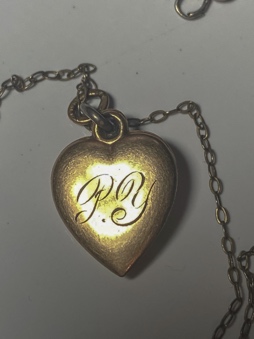
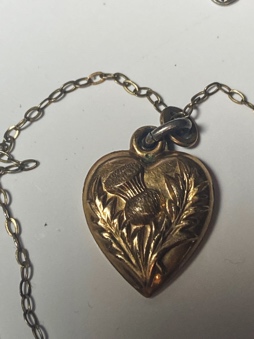
At her death, Paulina left no will and so her estate went into trusteeship until it was sold off. The real estate was valued at $33,350 and her personal belongings at about $1000. All proceeds went to Fritz. Sometime after her death, Aleda’s mother received a locket, most likely from Fritz. This is pictured here.
She was buried at Crown Hill Cemetery, in Crown Hill Park near downtown Denver. Of note, her tombstone reads Paulina M. Youngberg, the original spelling of her first name. Fritz J. lived for another six years and died in 1927 at age 57. He, too, is buried at Crown Hill, next to Paulina.